Open almost any student’s CV and the work-experience line says something like “handled customer calls.” It’s honest, and it could describe anyone. A hiring manager reading it learns nothing about how you think, what you noticed, or whether you can be trusted with access to anything.
That sentence is the whole problem in miniature. In security, you’re being hired to notice things, explain them clearly and be careful with sensitive information. A CV and an interview are your only chances to show those habits before anyone has seen you work. This guide covers how I’d structure a CV, how to turn lab work into bullets that say something, the questions I’d prepare for, and the mistakes I’d avoid.
A note on limits: I’m not a hiring manager, and I can’t tell you how any specific company screens applications. This is a candidate’s-eye guide built from public guidance and from the way I’d present my own work. For which roles to aim for and what to learn first, I keep that in my beginner cybersecurity roadmap, so this post stays on CVs and interviews.
How a CV gets read, and how to lay it out
Assume the first read is quick. Whoever opens your CV may be skimming dozens, and some employers run applications through software that tries to parse them. You can’t control either, but you can make your CV easy to skim and easy to parse:
- One page for an early-career CV, in a plain single-column layout.
- Standard section names (Summary, Skills, Projects, Experience, Education, Certifications) so both people and software can find things.
- No photos, icons, skill-rating bars or text boxes. They can scramble automated parsing and add nothing.
- A PDF, unless the application asks for something else.
Here is the layout I’d use, shown with a fictional candidate:
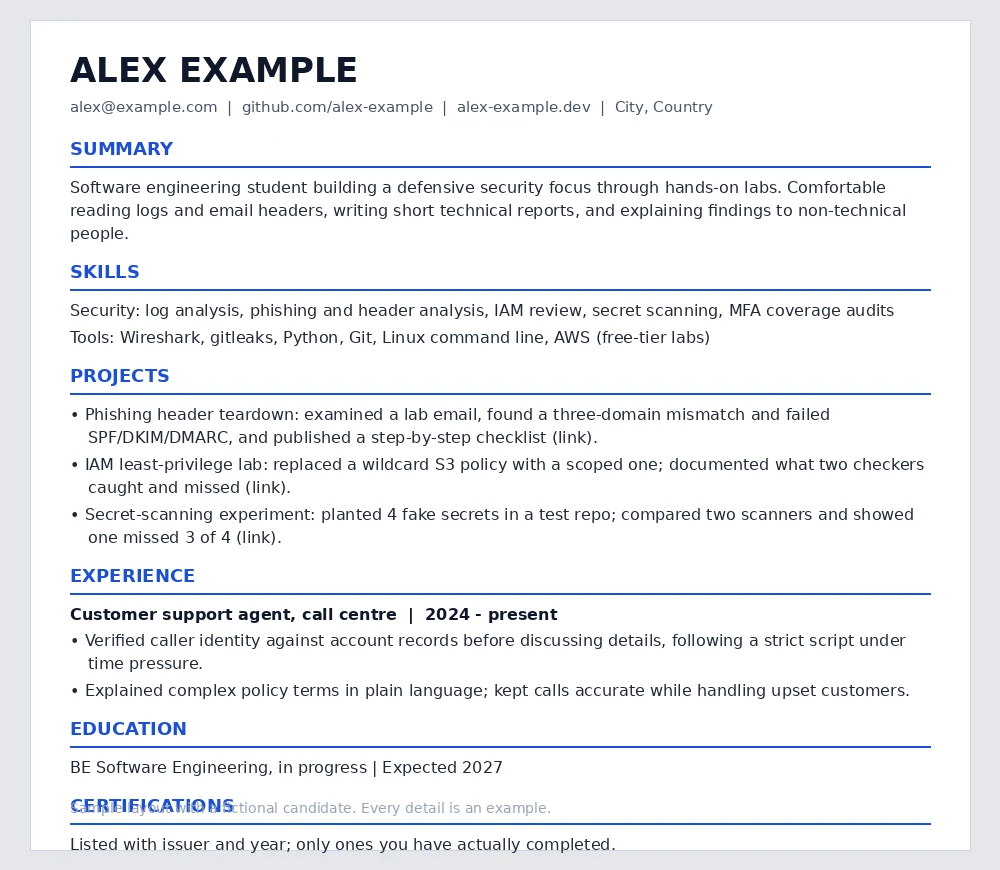
A few choices in that layout are deliberate:
- Projects come before experience when you have little or no security job history. Your projects are your strongest evidence, so they shouldn’t be buried at the bottom.
- The summary is two or three lines and says what you do and what you’re looking for, not “hard-working team player”.
- Skills are grouped into what you can do and the tools you use, not dumped as a cloud of buzzwords.
- Non-security work still earns a place. The sample’s call-centre job is there because identity checks, working to a strict process and staying calm with upset people are real, transferable habits. Describe those, not the routine tasks.
- Certifications sit last and stay short. List the issuer and year, and only ones you’ve completed.
Writing bullets that say something
Most weak CV lines describe a task. Strong ones describe an action, a tool and a result. A simple formula is: what you did, with what, and what came out of it.
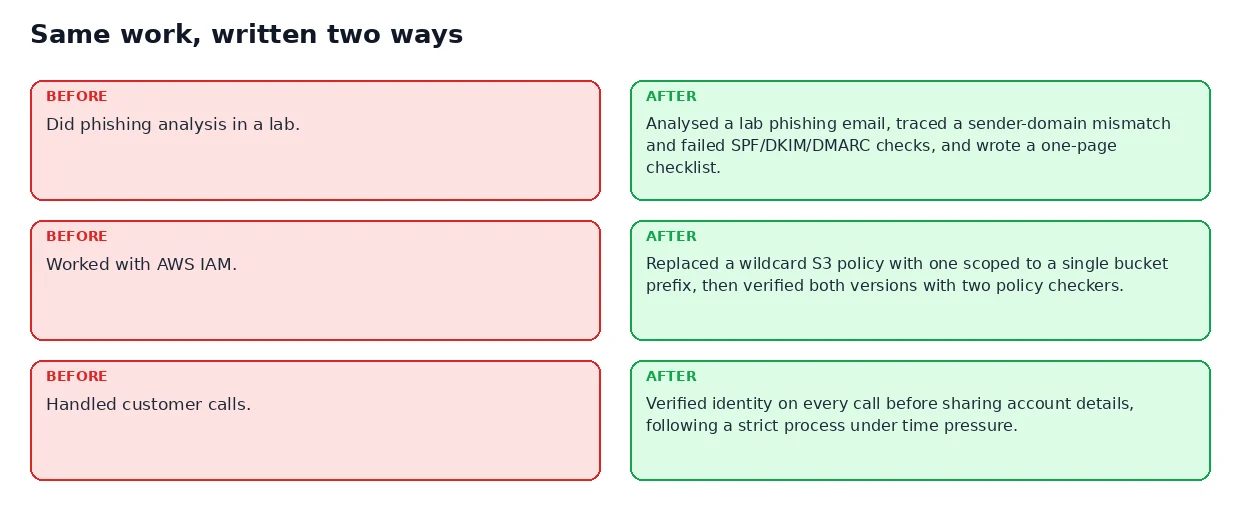
Look at what changed in each rewrite. The “before” lines name a topic. The “after” lines name a specific finding, a specific tool and something you can ask follow-up questions about. That last part matters, because an interviewer will pick one bullet and dig into it.
A few rules I’d follow:
- Only write what you could explain for five minutes. If you can’t answer “how did you do that?”, cut the bullet.
- Use numbers only when they’re true. “Reviewed 5 samples” is fine if you did. Don’t round up.
- Link to the work. A short write-up of a project gives an interviewer something concrete to open. For example, my phishing header teardown and IAM least-privilege walkthrough are the kind of thing a CV bullet can point to. Check that every link works before you send anything.
- Show how you work, not only what you found. A line like “documented what two scanners caught and missed” shows you test your tools instead of trusting them.
- Cut anything you couldn’t stand behind in the room. Every line is a question waiting to be asked.
The interview questions I’d prepare
Entry-level security interviews tend to mix four kinds of question. I’d prepare short answers for each, in my own words, not memorised scripts.
Fundamentals
Expect questions like “explain the CIA triad”, “how would you spot a phishing email”, or “what does port 443 do”. The trick is to give the definition in one sentence and then an example.
My version for the CIA triad: confidentiality is keeping data from people who shouldn’t see it, integrity is making sure it hasn’t been changed without anyone knowing, and availability is making sure the right people can reach it when needed. A bank statement shows all three: only you can see it, the numbers can’t be silently altered, and the app has to work when you need it.
For phishing, I’d talk about checking the sender’s real address and the reply address, reading links right to left, and noticing pressure to act quickly. CISA publishes plain-language guidance on this in its Recognize and Report Phishing page, which is worth reading before an interview.
For ports, know the common ones cold: 22 for SSH, 53 for DNS, 80 and 443 for web traffic, 3389 for remote desktop. Then be ready to say why an exposed remote-access port is a concern.
Incident handling
You might be asked “what would you do if you saw a login from two countries an hour apart?” There’s no single right answer, and interviewers mostly want to hear a calm, ordered way of thinking. NIST’s incident response guidance, SP 800-61 Revision 3, frames incident response as part of wider risk management and shows detect, respond and recover as the core of the cycle. You don’t need to quote it. It’s useful to know the shape.
Scenario questions
“A colleague says they clicked a link in a strange email. What do you do?” I’d answer with the same four-step shape every time.
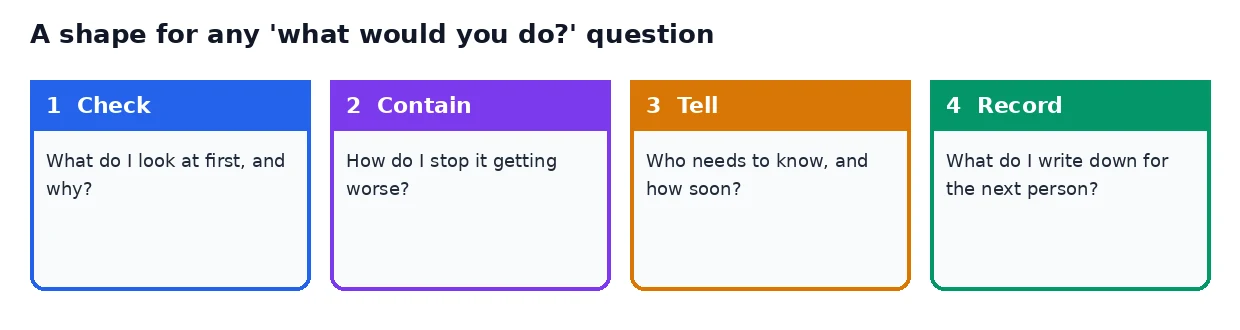
In practice that sounds like this:
- Check: ask what they clicked, whether they typed anything in, and look at the email’s headers and the link’s destination.
- Contain: if they entered a password, change it and sign out other sessions. Report the email so others don’t click it.
- Tell: let the right team know quickly, without blaming the person.
- Record: write down times, addresses and what was done, so the next person doesn’t start from zero.
I’d also say what I wouldn’t do: delete everything and move on, or investigate alone for hours without telling anyone. Saying when you’d escalate is a strong signal.
Behavioural questions
“Tell me about a time you handled a difficult situation” is where non-security work becomes useful. A simple structure is: the situation, what you specifically did, and what happened. Keep it to about 90 seconds. If you’ve done phone or customer-facing work, a story about verifying someone’s identity under pressure or calming an upset caller shows the habits security teams value: following a process, staying accurate and communicating clearly.
Rehearsing, and questions to ask them
Reading answers is not the same as saying them. A method I’d use:
- Write one-sentence answers for ten common questions.
- Say them out loud and record yourself on your phone for about 90 seconds each.
- Listen back for rambling, filler words, and places where you can’t explain a term you just used.
- Keep a “stuck list” of the questions that made you freeze, and go and learn those properly.
- Do a mock interview with a friend and ask them to interrupt with “why?” after each answer.
The “why” test is the useful one. If an answer collapses after two follow-ups, you’ve found something to study.
At the end of an interview you’ll almost always be asked if you have questions. Having none looks like having no interest. A few worth asking:
- What does a normal first month look like for someone in this role?
- How do you handle a new person’s first alerts or tickets, and who reviews them?
- What tools does the team use day to day?
- How does the team learn from incidents or near-misses?
- What would make someone successful here after six months?
Mistakes to avoid
- Claiming skills you can’t demonstrate. If a CV line mentions a tool, expect to be asked to explain it.
- Listing every tool you’ve touched. A long list reads as shallow. Pick the ones you can discuss.
- Posting lab screenshots with no explanation. A screenshot shows you ran something. A sentence on what you learned shows you understood it.
- Memorising answers word for word. It sounds rehearsed and falls apart on the first follow-up question.
- Sending the same CV everywhere. Re-order your skills and projects to match what each posting asks for.
- Typos and broken links. In a field about attention to detail, they count against you.
- Bluffing when you don’t know. “I haven’t used that, but here’s how I’d find out” is a much better answer than a guess.
- Having no questions at the end.
Where I’d start
If I were rewriting my own CV this weekend, I’d do four things: cut it to one page, rewrite every project line into action, tool and result, put a working link next to each project, and write down short answers to ten questions. None of that needs permission or money, and it all improves with a second pair of eyes.
I’m confident about the structure, because it comes from the kind of evidence interviewers can question. I’m less sure how much any single employer’s screening software cares about layout, and I haven’t tested these formats against specific systems. Treat the layout as a safe default and adjust to what each application asks for. Then ask someone to read your CV for ninety seconds and tell you what they remember. That’s what an interviewer will remember too.